The “Blurb” – A Writer’s Marketing Journey, pt 6

Everyone knows the ‘blurb,’ aka the quote usually on the back cover of a book that tells readers what’s go great about this particular book and why they should read it. But not every wrier may know how important and useful blurbs are.

What is a ‘blurb’?

In short, the blurb is a short paragraph recommendation written by some authority to endorse or recommend a book (you see them for films as well). In the world of books, however, especially with self- or independent publishing, authors usually solicit blurbs themselves from people whom they know or trust. More on that in a second.

In many ways, blurbs are the primary means of promoting a book and are often the last thing a customer will read before deciding to buy a book. In fact, BookBub (a book promo website) has done some tests to see what effect blurbs have on sales. One of the most effective elements they found in a blurb is that it come from a known author.

Whom do you ask for a blurb?

Since the most effective blurbs come from a previously known and published writer, that’s where you should start. This useful post by Diana Urban on how you can secure blurbs for your book has great practical ideas for reaching out to authors, even if you don’t know them. But I list below the qualities I think are most important in having from a recommender.

Someone with a high profile and good reputation. Those two qualities are crucial to an effective blurb that will pique reader interest and lead to sales. If they know the author writing the blurb, readers will take it more seriously. Carla Harryman, who wrote a blurb for my collaboration with Cheryl Pallant, Morphs, is a well-known and widely published poet; Cheryl and I were lucky and honored to have her write a blurb for us, as we were for our other blurbs by Mark Wallace and Christian Peet.

Someone you trust to give an honest but positive review. If you know writers, and most writers do, then reach out to them and ask for reviews and/or blurbs. Blurbs are much easier than reviews, but writers you know might be willing to do both. They also are more likely to write positive, glowing reviews that highlight the strengths of your book.

It may go without saying, but honest and sincere blurbs are more effective than forced ones. Blurbs with some constructive criticism have much more weight than ones that damn with faint or fake praise. So, even if you get a blurb that you don’t interpret as 100% positive, using it may still help you sell your book.

Someone who writes in your genre. Since people tend to read by genre, having an author they know from the genre they love (yours) will make them even more effective. On my book, Poetic Obligation, I asked two writers who write in the same field as I did. Even though they are the ‘competition,’ most writers know a rising tide lifts all boats in the publishing world.

Authority of some kind. Does the efficacy of author-written blurbs mean that I shouldn’t use a blurb from an institution or publication? Not at all, blurbs from authorities of any kind (critics, bloggers, newspapers, magazines, publishers, agents, etc) can be useful. If you get your book reviewed by the New York Times or Publisher’s Weekly, by all means use it, but just make sure you have a good portion from real, live authors.

Where do I start?

Your own blurb is where to start. Every book must have a ‘pitch,’ ‘logline,’ or one-sentence summary from its own author. It usually takes the form of: “The book [title] is a [subgenre] about a character [name] who does [x, y, and x] to obtain a [goal] against obstacles [a, b, and c]. The blurb for my novel, Ivory Tower, goes like this:

Ivory Tower is a crime thriller about Margolis Santos, a charismatic film professor in her prime, who risks her career and life to uncover sexual corruption inside her university’s football program where rich boosters pay sorority girls to have sex with star recruits.

This one sentence has to be substantial and engaging yet concise and readable enough to hook a potential reader, so spend time working on it and show it to as many people as you can. Get feedback and continually revise it throughout your writing process.

Where do you put blurbs?

The great thing about blurbs, because of their short length, is that you can use them in multiple places. Most books–and perhaps the most important location for a blurb–have them on the back cover so when potential readers flip it over, they are the first things seen. Due partially to my press’s house style and partially because I waited to long to ask for blurbs, my novel, Ivory Tower, does not have them on the back cover. But I still asked for them to use in other places.

You will not only put this blurb on your book cover or inside jacket, but it will also be a part of:

  • your advance info sheet,
  • query letters to reviewers and publisher,
  • website and
  • most of your other promotional materials.

When do you ask for blurbs?

Ideally, you want to ask for blurbs as soon as you know your book is going to be published. Even before you know your release date or have a final proof copy in your hand, I recommend that you reach out to authors you know, authors you want to be like, and authors who write in your genre. The earlier the better.

That way, when you get blurbs, you can add them to your cover (before it is designed), your promotional materials, and your website and bookseller sites.

Do you have any horror or success stories about blurbs? Share them in the comments below!
Author’s Marketing Journey, pt. 5 – Website Building

I spent the entirety of my ‘Marketing Monday’ working on my website: grantmatthewjenkins.com. Most authors, particularly novelists, have them these days, and a website is an essential part of any marketing plan whether your are rep’d or self-published.

Where do you start?

For my website, I used the open-source, web-based software, WordPress, because I have some experience using it for some of my other projects. Everyone likes to say that its ‘easy’ but even for someone like me who has done some HTML and CSS coding, designing a website can be difficult and frustrating. There are other services like Weebly or SiteBuilder, but you can also use Adobe DreamWeaver or even Microsoft Word.

WordPress, despite its complications, has its strengths. First of all, it is fairly intuitive to use. Their visual editor, Gutenberg (yes, that Gutenberg) makes website building a little like word processing. You literally build your site out of figurative ‘blocks,’ that have different purposes (image, list, text, etc).

Secondly, their service is world-class. Tech agents get back with you quickly via email, and the chat help is fantastic. They’ve helped me through some sticky situations where I was getting very obsessive and angry.

Free or Paid?

WordPress has five plans to choose from. It does have a free service that you can build a website quickly and cheaply. It comes with free templates and access to most of the basic blocks you need to get started. The Personal is $4/mo. while the Premium plan is $8/mo., and both allow you to use a unique domain name, not just https://www.wordpress.yourname.com

If you want a unique domain name, you’ll have to pay for it or buy a WordPress plan. For me, it was worth it to have a website that was easily remembered as my full name. Luckily, there aren’t many Grant Matthew Jenkins’s out there.

You can check the availability and purchase site names through web hosting sites like Domain.com or GoDaddy. It costs around $13 a year for a name, and you have to renew it annually, or you could lose it and have to pay to fee to unlock it or buy it back from someone else. Choosing ‘auto-renew’ can save you headaches.

Nobody tells you this up front, but if you want to do more advanced things with your website, like sell books, you’ll have to pay for a premium plan, either Business or eCommerce. For authors, I recommend the former, unless you are doing hella traffic and moving lots of books and merchandise. I bit the bullet because I think I can recoup my costs just on the higher margin I’ll get from selling books on my site.

Choosing a Design

All web design software comes with free and, if you upgrade to Business like I’d did, premium templates. None of them are perfect–I’m a little pick about the way things look–but they can really help you if you are not a design expert. There are even template geared towards authors who want to sell books, like “Book Landing Page” and “Author Landing Page.” I went with the latter because it is clean and bright. Simple.

You can also buy template and plug them in (‘plugins’ are small applications that you can integrate into your WordPress site that expand its functionality). Prices vary widely. On my budget, I went with a template that came with the WordPress Business Plan.

Pro Tips for Web Sites

Here are some hard lessons I’ve learned managing my several websites, and I hope you find them useful as you think about your web presence:

  • Remember, effective websites are visual. Use lots of photos of you, your books, and your life to make it captivate your audience.
  • Update often. Keep your website maintained and up-to-date. Fix dates, names, and info, especially with things you are doing or selling.
  • Use the blog feature of your website, if it has one, to keep in front of your reader. Link your blog to your social media site so that posts automatically show up, or, if you don’t want a Business Plan, just cut and past links to tweet, post, and pin.
  • Don’t put too much on one page. Scrolling is a pain. Use links to multiple pages with different functions (home, blog, about me, etc) so most of you information appears on the screen at once.

OK, that’s all for now–I have to get back to obsessively futzing with my own site to get it just right! Leave comments about your experience with web design down below.

Proof and Publication Date

I think we’ve finally figured out all the problems with the proof copy of Ivory Tower, but considering all of the issues I’ve had and time I’ve spent on it, I’ve decided to push the release date of the book back to Feb 1.

That will give me time to get hard and electronic copies to all the review outlets I want as well as time to get some publicity before publication. Don’t worry, you can still pre-order the book through Amazon or directly through me!

Problems with the new proof

If I could put a frown emoji here, I would. (Not really, ha ha.) But I must admit that it’s frustrating to receive a new proof of my novel and still find problems in it.

Let me just say here that I am confident that my publisher, Nick, will fix it and make sure things are right before my book launches. Having said that, let’s look at the issues that came back this time.

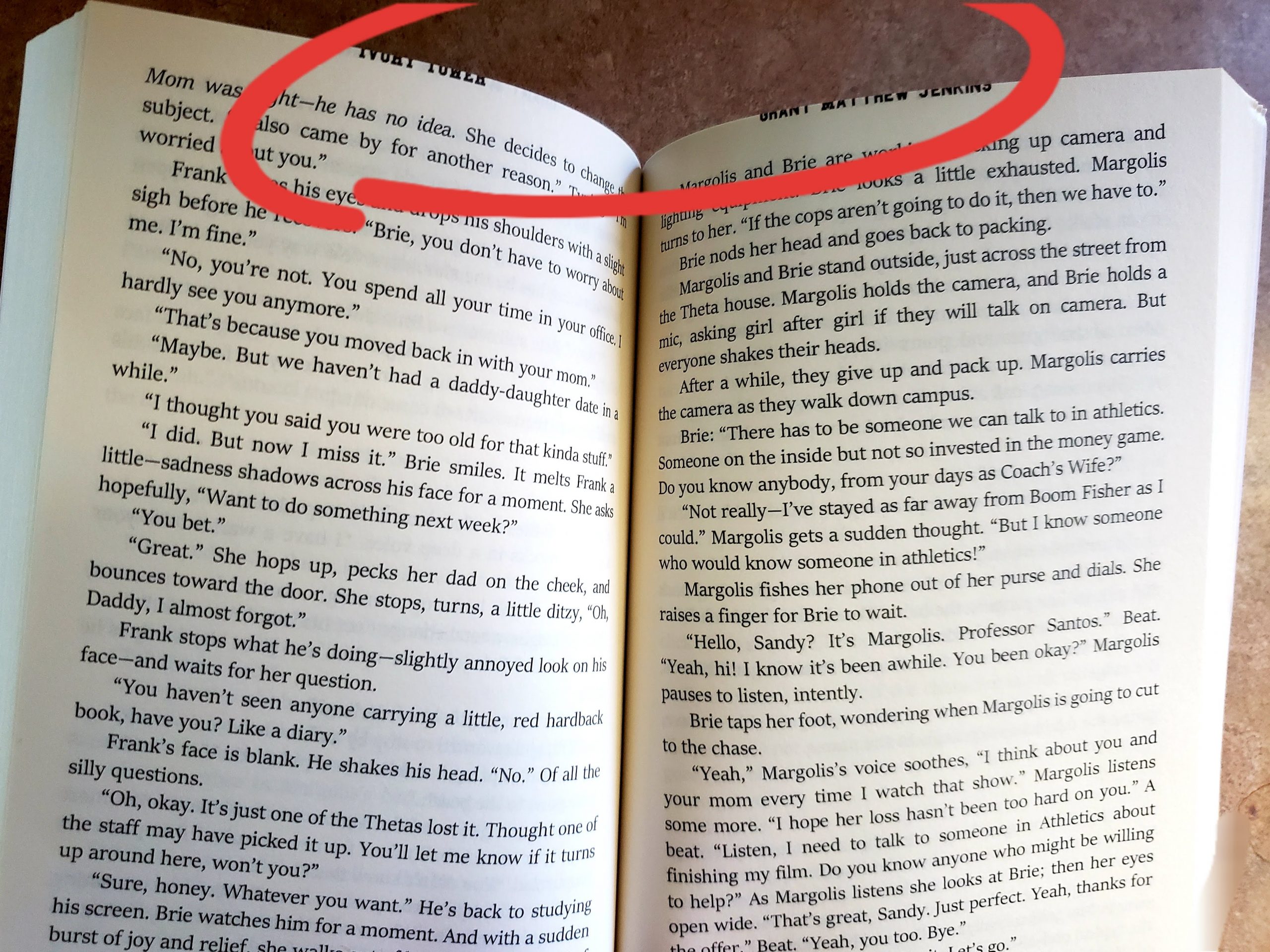
As you can see from the photo above, almost half the page is blurred or smudged. Not attractive. Apparently, this was a printer error, and my book was not the only on affected, which is slight consolation.

What you may not be able to tell from the photo, is that it appears there is too much space above the header and not enough below the page numbers in the footer. It looks like the page is off-center vertically. See what I mean.

I’m sure others have horror stories about proofs–anyone have to go through more than one proof copy to get things right?

An Author’s Marketing Journey, pt 4

I’m learning that marketing and promoting your own book is a long haul or, if you prefer a sports analogy, a four-quarter game. Although it is tempting to skip “Marketing Monday,” or whatever time you’ve set aside to do this PR work, perseverance is more than half the fight.

For Its Own Sake

One of the things that makes it hard is that you may not be seeing tangible results of your efforts right off the bat, especially if you are, like me, a first-time novelist. My other books–poetry and academic scholarship–weren’t about sales or popularity because they served other functions in my career. But now, I want people to read my book, and that means starting from scratch.

One of the ways I deal mentally with this problem of “Is it working?” is to see the marketing and promo efforts as an end in themselves. In other words, just writing, thinking, and sharing about my book is reward enough. I’ve learned a lot about my writing process, my goals as a writer, how my books fits into a particular genre (or not), and who might be my audience.

Specifics

Having said all that, let me talk about the tangible things I’ve done this week to further my goals of selling 10,000 books:

  • Worked on my Goodreads Author Profile – to wit, I answered a few questions about my book, inspiration, and process so that when curious readers come looking (and I hope they will) they can find answers to some of their questions. Plus, it was kinda fun for me.
  • Ordered advanced copies of the book to send to reviewers. Many review outlets, especially newspapers and magazines, will only accept hard copies of books to consider for review.
  • Continued reading my flawed proof copy for more errors. I want my baby to go out into the world without a blemish!
  • Connected with some old friends and students who are writers or who might be interested in my book.
  • Posted a photo of the book on Instagram. And got lots of supportive responses!
  • Contacted local media (this time, the daily Tulsa World, along with the local weekly rag, The Tulsa Voice, which I love).
  • Got an encouraging email from the Publisher’s Weekly online review site, Booklife, that my novel had cleared a first hurdle toward being chosen for a free review (they also have pay services, btw).

What are some things you’ve done recently to promote your writing career and recent work?

What happens at the proof stage of publishing?

In my last post, I announced that I got the proof copy of my novel, Ivory Tower, in the mail from the publisher, which was great. Proof copies let you take one last look at your book–the physical book itself–before it goes out to the world. Whether you are publishing with a big house or self-publishing, you should always look at proofs in physical form.

When I started to look closely at mine, I noticed a problem: the pages didn’t seem to fit the book!

As you can see, the title and name header on each page is cut off:

When I told Nick, my publisher, about it, he told me that the printer had used the wrong size paper, which didn’t give the interior text enough space. Problem identified.

This is why you look at proof copies!

To make sure everything looks good.

Plus, I’ve been reading it and actually have found some typos and orphans (single words or phrases left on a single page). So, having one last chance to try to make things perfect is a good idea.

Anyone else have any proof-stage horror stories? Leave them in the comments section!

Author’s Marketing Journey, pt 3

Today, I focused on connecting with bloggers, either requesting reviews of my novel, Ivory Tower, or asking to be part of a blog tour. If you have never heard of a “blog tour,” check out this great explanation by children’s book author, Nick Jones, on the Irish magazine, writing.ie, itself a great resource for both readers and writers.

Bloggers, people who spend their time writing online, often for free (like me), can be a god-send for independent authors. Many bloggers focus on doing book reviews and earn readers’ trust through the quality and reliability of their writing, taste, and judgment.

Book review blogs can be small, with a few hundred or thousand followers, like Barbara Gipson of A Different Kind of Read, who specializes in ethnic or special needs publications, to Book Riot, a wide-ranging review magazine based in Toronto with a large stable of contributors who reach a broad audience of approximately 1 million monthly visits.

How do you find blogs that might be interested in your kind of book?

Reedsy, another author resource site that bills itself as “a full ecosystem for authors and publishing professionals,” has a searchable database of bloggers that allows you to filter by genre so that you are inquiring only bloggers who might be interested in your type of book.

Today, I sent out over a dozen queries and requests for reviews. Be aware, though: many bloggers are overworked or backlogged, so you want to tap them early in your marketing plan and expect lots of silence.

Had an experience querying bloggers or purchasing blog tours? Leave a comment!

Proof copy is here!

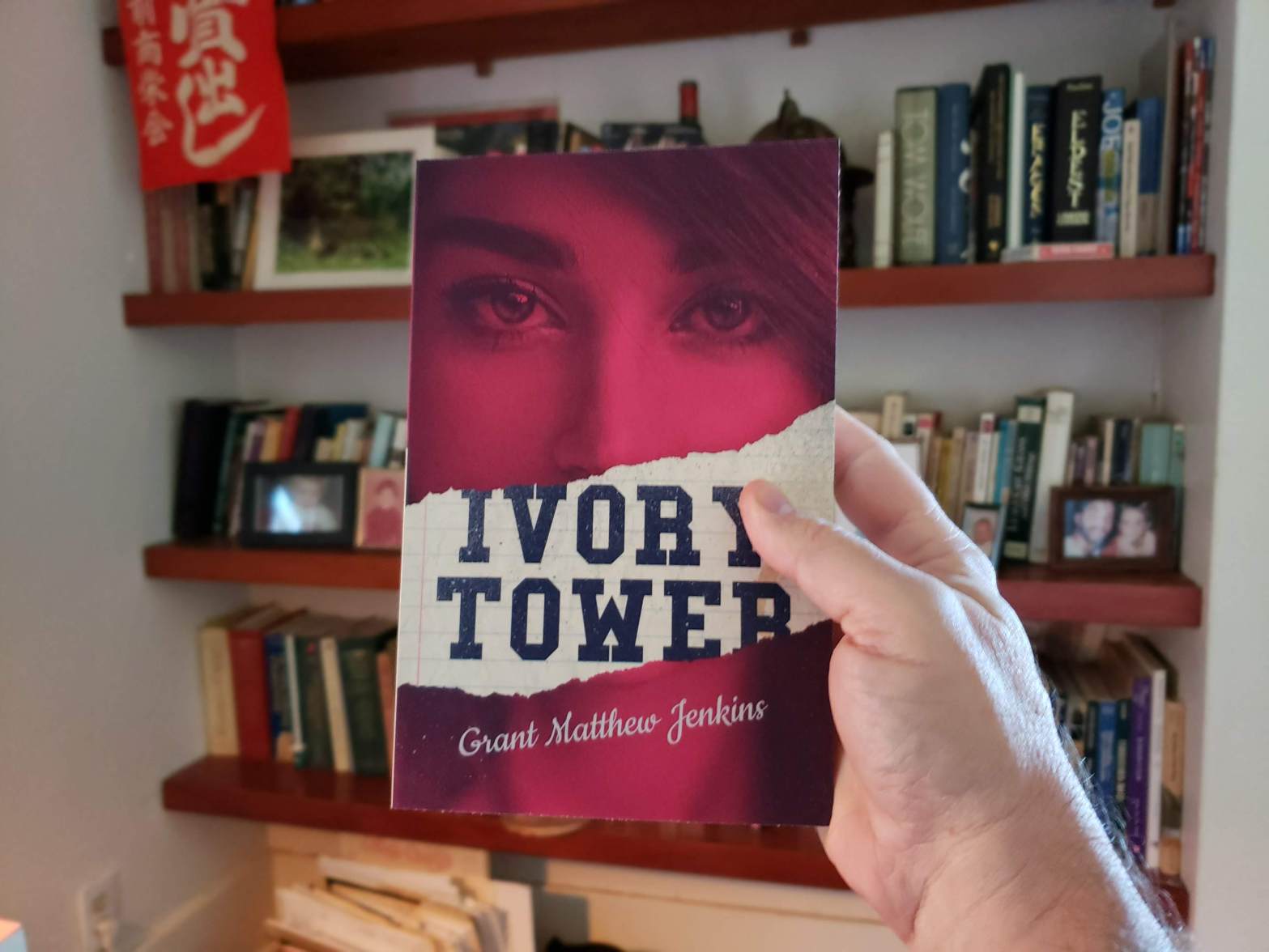
Ahhh, there is nothing like holding your own book in you own hand for the first time. The weight of it, the texture of the cover (matte, in this case), and the sense of accomplishment that comes with it.

I always advise my student writers to revel in moments of accomplishment and bask in their laurels because those moments sometimes come so seldomly. Any even now–because I want to put my novel out into the word, have lots of people buy it and love it, and for it to be a success–I am having to remind myself to appreciate what I’ve made.

But breathe. Here’s moment: My book has arrived.

How did you feel when you got your first piece of published writing in hand? What do you imagine or hope it will feel like?

Author’s Marketing Journey Pt 2 – What is an Advance Info or “Sell” Sheet?

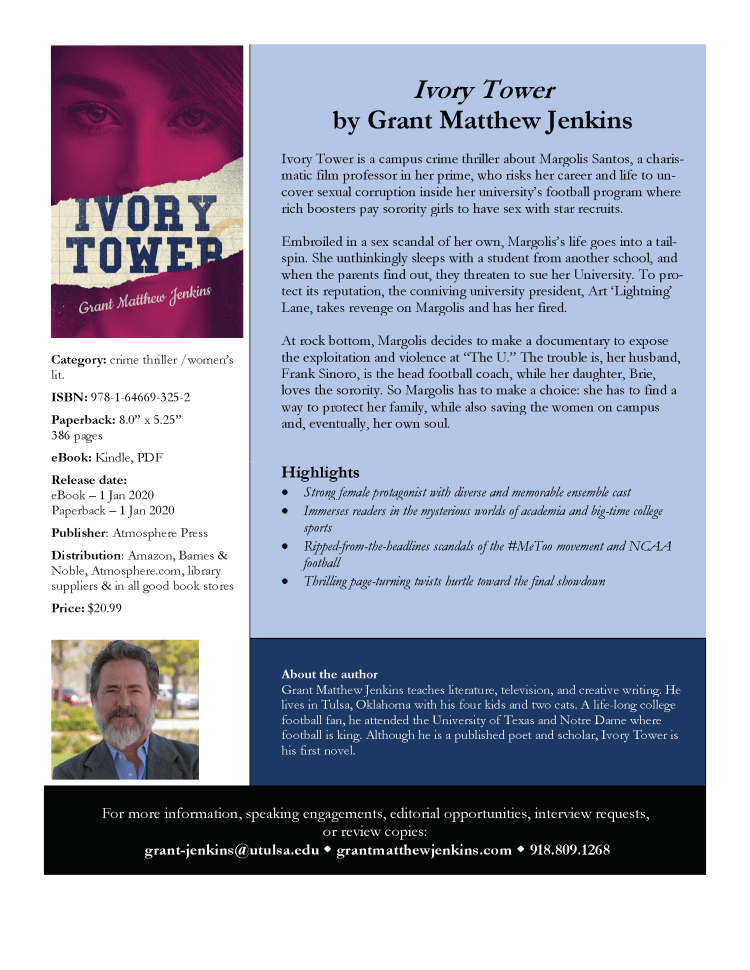
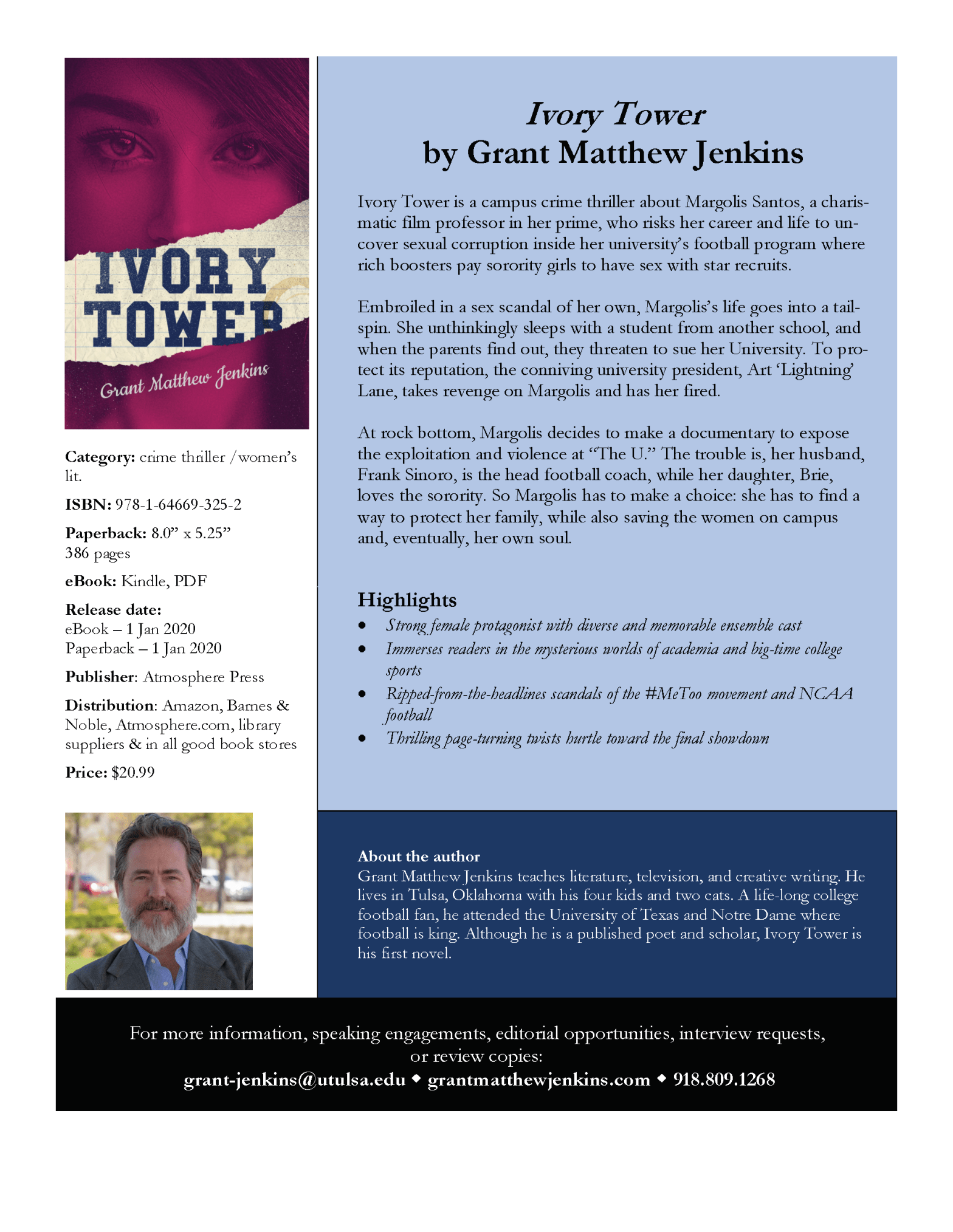
In my last post, I included an image of the Advanced Info Sheet (AIS) for my novel, Ivory Tower. Here it is again, in case you missed it:

My “Advanced Info” or “Sell” Sheet

This document is used by publishers (like yourself) to inform venues, magazines, reviewers, and distributors about a new work. It’s also called a “sell sheet” among other names, and it’s an important weapon in your marketing arsenal. As author Debbie Young writes on the ALLi blog, using an AIS, “shows we speak the bookseller’s language. It shows we respect reviewers’ time and needs.” She also gives some great advice and good-looking examples on that page, but you can find other examples with a simple web search. They are ubiquitous.

One element I did not include in this version are blurbs, and that is because I don’t have any yet. Yes, people have read my novel, but I unfortunately have not asked any of them to write a review yet. My bad. So, I had to make an AIS in order to get reviews. When I have some, I will update the sheet with a “What People Are Saying” section.

So, some things I learned about AIS and their use:

  • Make one as early as you can, ideally a year before your publication date. Start making it when you get close to ready to submit for publication, at least.
  • Look at many examples and employ elements that fit your needs. Some elements are required (ISBN, pages, genre, format, pub date, publisher, distributors) but others can be tailored.
  • Include a photo the cover. If you don’t have a cover yet, or an ISBN for that matter, you aren’t ready to make an AIS or send one out.
  • Make it attractive through use of color, layout, balance, and other design elements. Get help if those things are not your forte.
  • Distribute it widely – this is your book’s calling card.

Anyone else have advice or lessons-learned about AIS’s? Leave a comment!

Jan. 1st Release Date!

Atmosphere Press has just announced that my latest book, Ivory Tower, will be released on January 1, 2020! What a way to ring in the new year, ay? It will be available on Amazon January 15, but you can pre-order it now!

Ivory Tower is a campus crime thriller about Margolis Santos, a charismatic film professor in her prime, who risks her career and life to uncover sexual corruption inside her university’s football program where rich boosters pay sorority girls to have sex with star recruits.

You can read an excerpt here on Wattpad. Let me know what you think, and, please buy a copy!